The tiny marks inside a ring
Hallmarks and Stamps: How to Read Them

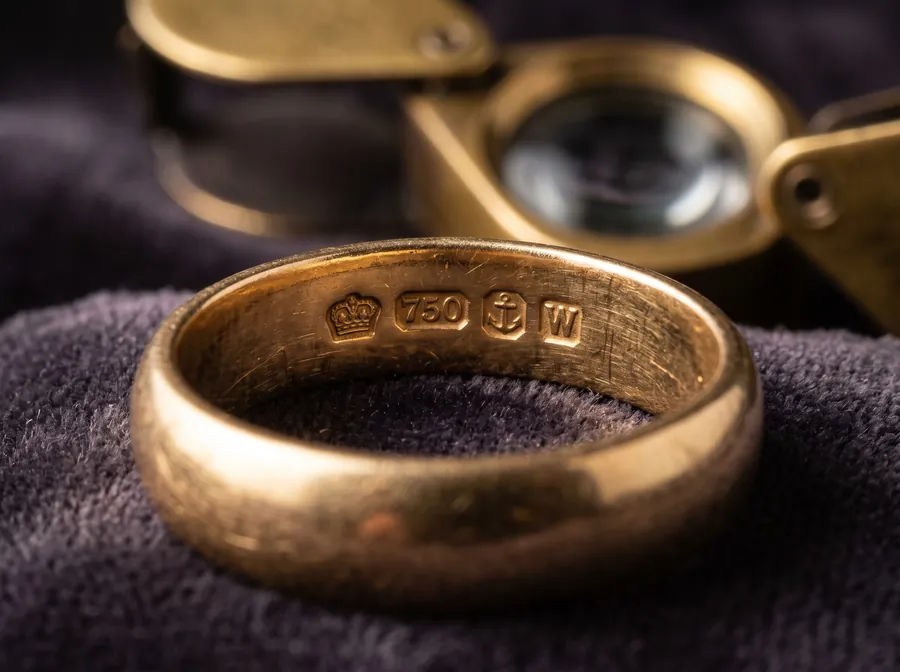
Inside almost every ring is a line of tiny marks that tell you what it is made of, who made it and sometimes exactly when. Reading them takes a loupe and five minutes of vocabulary.
Purity marks
The number stamp: 750, 585, 375 for gold; 925 or 800 for silver; 950 or 900 for platinum; PD950 for palladium. In North America, karat marks such as 14K or 18K are used instead. A purity mark alone is a manufacturer’s claim; in some countries it is independently verified, in others it is not.
Hallmarks: the guaranteed kind
A true hallmark is applied by an independent assay office after testing the metal. The United Kingdom has the strictest system: a sponsor’s mark (the maker), a fineness mark in a shaped shield, an assay office mark (a leopard’s head for London, an anchor for Birmingham, a rose for Sheffield, a castle for Edinburgh) and often a date letter. Switzerland, France, the Netherlands, Portugal, Ireland and several other countries also hallmark by law. Germany, Italy and the United States rely on the manufacturer’s stamp, backed by fraud law rather than assay.
Maker’s marks and signatures
Fine houses stamp their name or a registered symbol, a serial number and often the metal purity in their own format. A signed piece from Cartier, Van Cleef & Arpels, Bulgari, Tiffany or Boucheron is worth far more than its metal, and forged signatures exist. Genuine marks are crisp, correctly placed and consistent with the house’s known style for the period; auction specialists check them against archives.
Date letters and convention marks
British hallmarks include a letter that changes each year, so a piece can be dated to the year. The common control mark, a set of scales in a shaped outline, is recognised across countries that signed the Vienna Convention and guarantees purity internationally.
Stamps that mean “not solid gold”
GP (gold plated), GF (gold filled), RGP (rolled gold plate), HGE (heavy gold electroplate), 1/10 or 1/20 followed by a karat mark, and vermeil. Silver marked “German silver” or “nickel silver” contains no silver at all. Stainless steel and titanium are often marked as such.
When marks are missing or worn
Old pieces, repaired pieces and pieces from countries without a marking tradition may have no stamp. Buyers test with acid, electronic testers or X-ray fluorescence, which reads the alloy in seconds without damage. An unmarked piece can still be 18K; it simply has to prove it.
Questions people ask
Is a stamped 750 mark proof of 18K?
In hallmarking countries, yes, because the assay office tested it. Elsewhere, it is a claim that is usually true and always tested by a buyer.
What does a number like 1837 mean on a Tiffany piece?
It is the founding year, used as a design signature, not a purity or serial number. Purity is stamped separately.
Can a hallmark be forged?
It happens, mainly on signed pieces. Assay offices and auction houses detect it by style, placement and archive comparison.