Cut, colour, clarity, carat
The 4Cs, Explained Without the Sales Talk

Every diamond is sold on four letters. Only two of them are visible to you on a hand. Here is what each grade changes, what it costs and where a good buyer spends and saves.
Cut: the grade you can see from across the room
Cut is not the shape. It is how well the facets are angled and proportioned so that light entering the stone comes back out through the top. A well-cut diamond looks bright and lively; a poorly cut one looks glassy or dark in the middle even if its colour and clarity are perfect. Laboratories grade round brilliants from Excellent to Poor. For round stones, Excellent or Very Good is the only place to be. Fancy shapes such as ovals and cushions have no cut grade from most laboratories, which is why they need to be seen, or at least seen in a video, before buying.
Colour: D is colourless, and you will not see J
Colour runs from D (colourless) to Z (light yellow or brown). The differences between neighbouring grades are invisible to almost everyone once the stone is set. D to F are colourless, G to J are near-colourless and look white in a setting, K and below start to show warmth. In yellow or rose gold, an H to J stone looks identical to a D and costs a fraction. In platinum or white gold, most buyers stop at G or H.
Clarity: eye-clean is the only grade that matters
Clarity describes inclusions and blemishes seen under ten times magnification. FL and IF are flawless, VVS1 to VS2 have inclusions that are difficult or somewhat easy to see under the loupe, SI1 and SI2 have inclusions that a loupe finds easily and that may or may not be visible to the naked eye, and I1 to I3 have visible flaws. The trade word to learn is eye-clean: a stone whose inclusions cannot be seen without magnification. Many VS2 and SI1 stones are eye-clean and cost far less than VVS stones that look exactly the same on a hand.
Carat: weight, not size
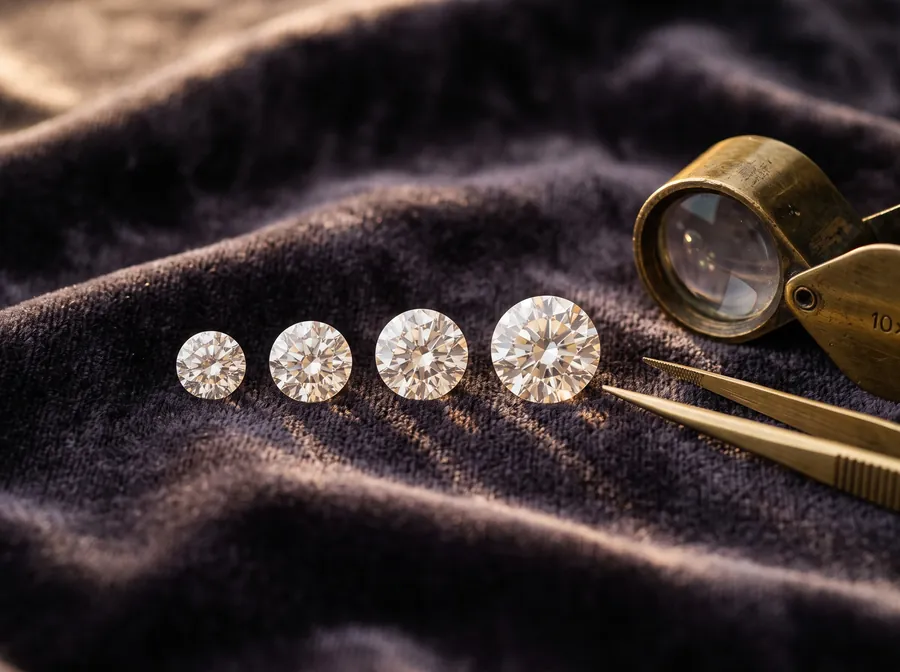
A carat is a fifth of a gram. Price per carat jumps at the round numbers, half a carat, one carat, two carats, because demand does. A 0.90 carat stone can cost fifteen to twenty percent less than a 1.00 carat stone of the same quality and look the same to anyone who is not holding a scale. Spread, the diameter of the stone, depends on cut as much as on weight: a shallow stone looks larger than its weight, a deep one smaller.
Where the money goes
If you rank the 4Cs by how much they change what you see, the order is cut, carat, colour, clarity. If you rank them by how much they change the price, the order is carat, clarity, colour, cut. That mismatch is the whole art of buying well: spend on cut, be sensible on carat, relax on colour and clarity down to the eye-clean, near-colourless zone.
The fifth C
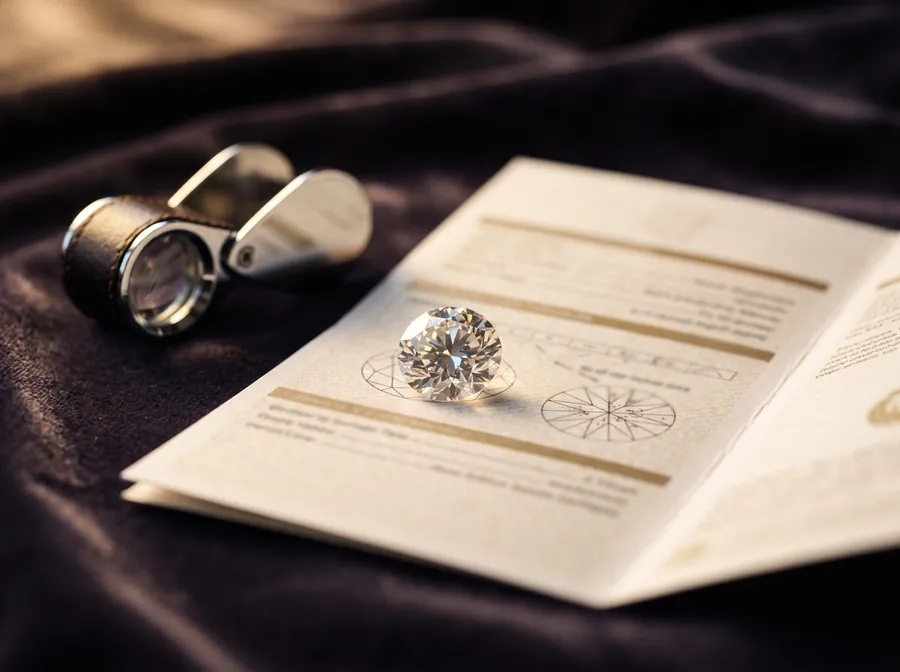
Certificate. A report from GIA, IGI or HRD turns adjectives into grades you can compare between jewelers. A diamond sold with a shop’s own appraisal is graded by the person selling it. Our guide on reading a diamond certificate explains what to look for.
Questions people ask
Is a higher clarity grade always better?
Not visibly. Above VS2 the differences exist only under magnification. Pay for a higher grade if you want the certificate to say it, not because the stone will look different.
What does fluorescence mean on a report?
Some diamonds glow blue under ultraviolet light. Medium or strong fluorescence can make a stone look slightly milky in daylight, but in near-colourless stones it can also make them look whiter. It usually comes with a discount, which can be a good deal if the stone is checked in daylight.
Are the 4Cs the same for coloured gemstones?
No. Coloured stones are judged first on colour, then on clarity relative to their type, and cut grades do not exist in the same way. See our gemstone guides.