De Beers London · High jewelry
De Beers London Vibrations: High Jewelry Shaped by Rivers, Waterfalls and Frost
De Beers London has turned water into high jewelry. Vibrations follows rivers, waterfalls and frozen landscapes in Africa and the Canadian Arctic, and it brings two things the diamond world rarely sees: rough stones set beside polished ones, and diamonds cut as smooth cabochons.
The newest high jewelry from De Beers London is about water, the inland kind that carves canyons, falls from cliffs and freezes into flowers of ice. Vibrations, presented in September 2026, began with Echo, a set first shown in January and inspired by the Fish River Canyon in Namibia. Three new suites now join it, each dedicated to a body of water in Botswana, South Africa or Canada.
Emmanuelle Nodale, CEO of De Beers London, describes the aim as a distinctive kind of high jewelry, “rooted in our connection to the source”. That connection is the argument of the whole collection: De Beers calls itself the only house with a direct link to where its diamonds come from, and Vibrations includes seven stones from its Natural Works of Art collection, among them Fancy Pink and Blue diamonds.
Echo and Cascade: a canyon and a waterfall
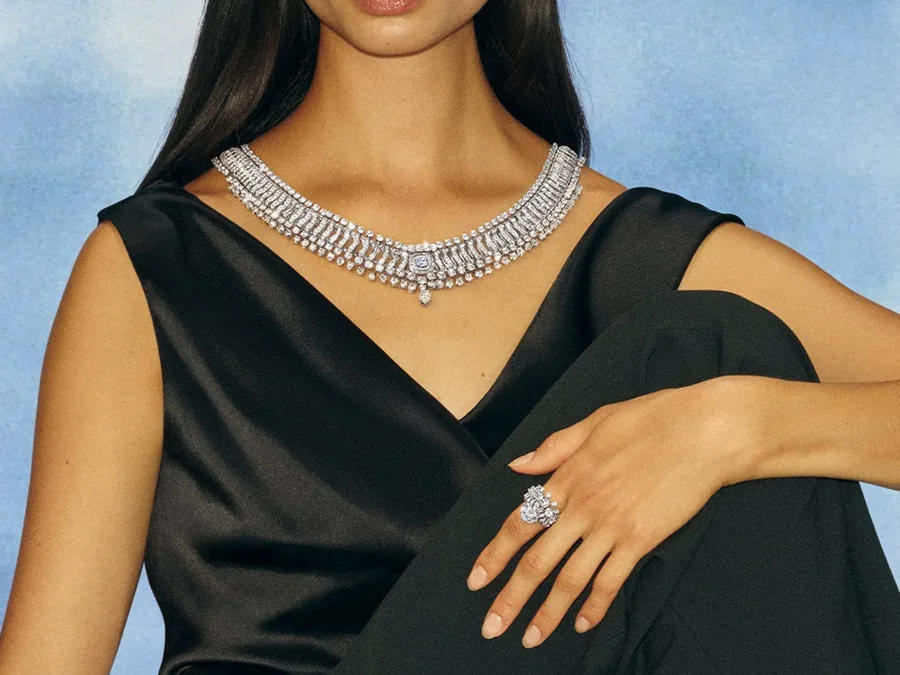
Echo has five pieces whose ripples recall the rings that spread when a pebble drops into water. Polished white diamonds sit next to rough alluvial ones, and the centrepiece is a transformable necklace with a 1.12-carat Fancy Intense Blue diamond from Namibia. It comes apart into six jewels, among them a tiara, a bracelet and earrings, the most technically complex piece De Beers London has unveiled so far. The set also includes a ring with a 5.21-carat D Flawless diamond.
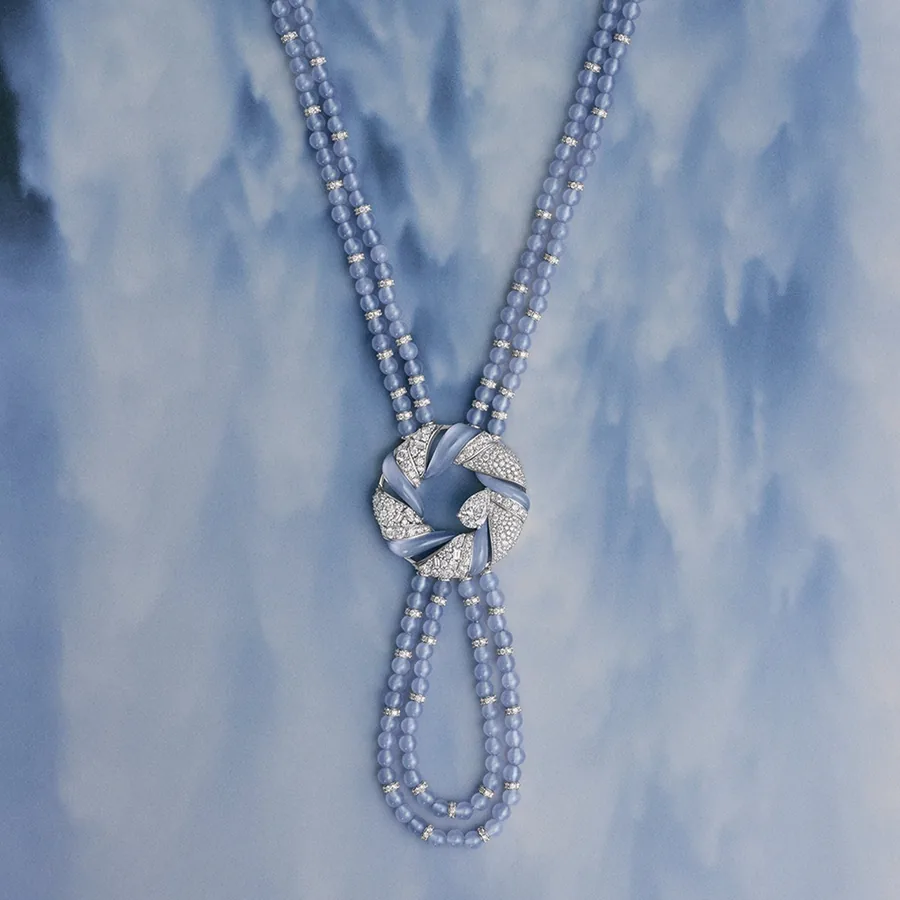
Cascade takes its cue from Tugela Falls in South Africa, the highest waterfall in Africa, which drops more than 980 metres over basalt cliffs. Its four pieces bring soft-blue chalcedony into De Beers London high jewelry for the first time: a long sautoir of chalcedony beads from Namibia, earrings with a removable chalcedony tassel and carved chalcedony from Kenya, set among round, pear, oval, baguette and princess-cut diamonds.

Shimmer and Undulation: Arctic pink and Okavango green
Shimmer looks north, to the frost flowers of Ellesmere Island in Canada and the pink light of the polar dawn and dusk. Its seven pieces use lace-like motifs and unusual cuts such as triangles and navettes, plus four rare Fancy Pink diamonds, including a pair from the Argyle mine. The Shimmer Masterpiece Necklace carries a 2.07-carat Fancy Intense Pink diamond found in Botswana; a ring holds a 0.81-carat Fancy Intense Pinkish Purple.
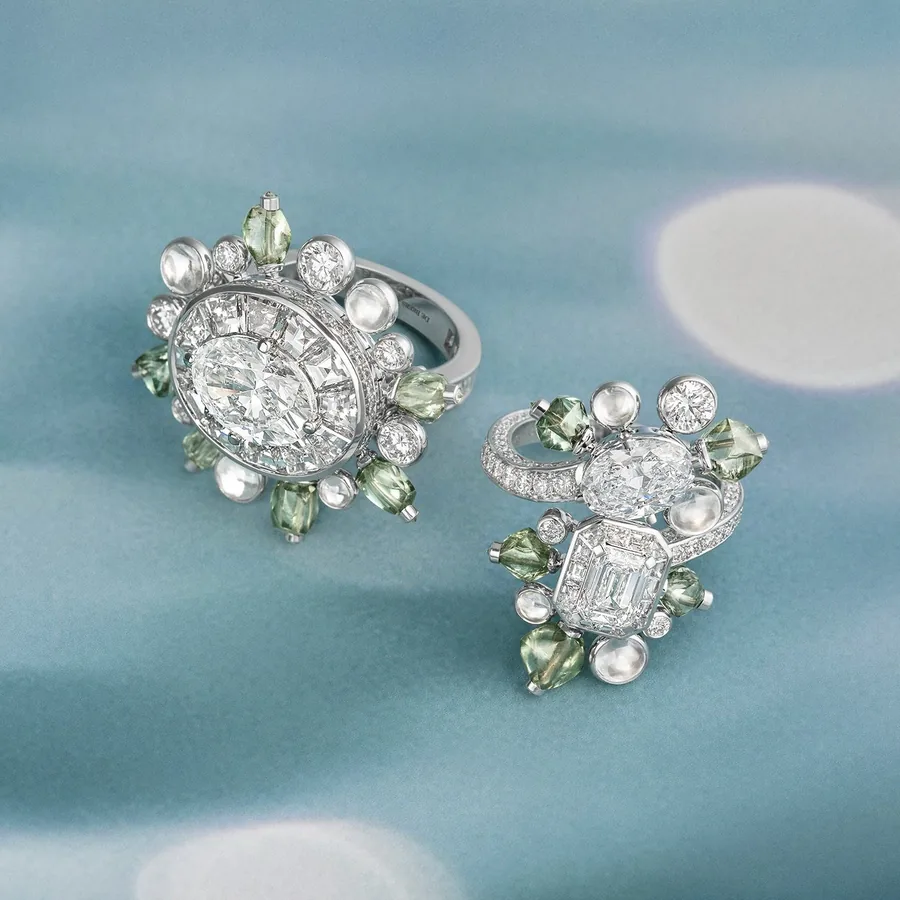
Undulation is the tribute to the Okavango Delta in Botswana, the largest inland delta on Earth, whose source waters De Beers protects with the National Geographic Society in a project called Okavango Eternal. Its six articulated pieces are trimmed with rough green diamonds. De Beers puts their rarity in numbers: of every 10,000 fancy coloured diamonds found, only ten are naturally green.
Two firsts: rough GemFair stones and cabochon diamonds
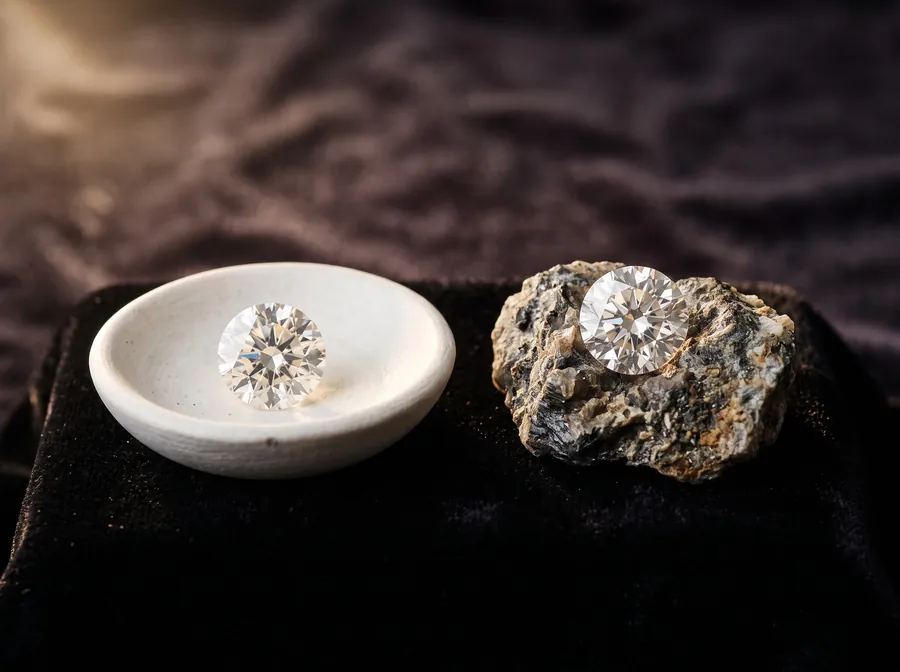
Running through all four suites are rare alluvial white diamonds, shaped by river currents and found by independent artisanal miners on ancient riverbeds in Sierra Leone. They come through GemFair, a sourcing initiative that supports artisanal miners with traceability, fair prices and community development, and they appear in De Beers London high jewelry for the first time, both rough and polished.
The second first is a cut. Undulation is finished with cabochon-cut diamonds, smooth and domed like drops of water, which glow rather than sparkle. Developing the technique took five years, because a cabochon has no facets to hide inclusions and diamond is extremely hard to shape this way. According to De Beers, fewer than 0.5 percent of diamonds meet the colour and clarity it requires.
Our view
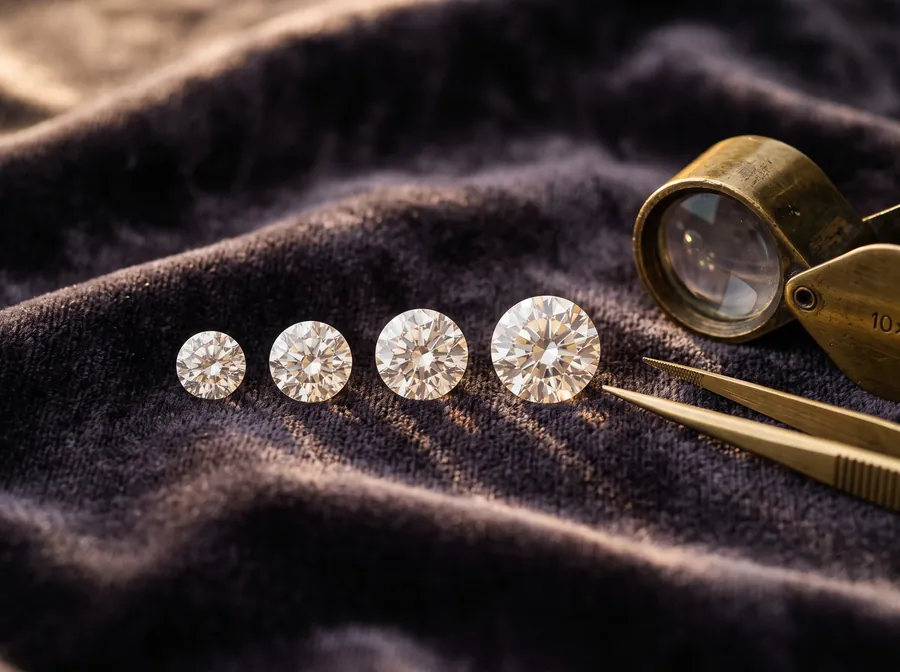
For a buyer, Vibrations is a useful lesson in how diamond grades are written. D Flawless is the top of both the colour and the clarity scale; our guide to the 4Cs explains what each step below it costs. Coloured diamonds are graded differently: the word after “Fancy” describes the depth and strength of the colour, and for pink and blue stones that word matters as much as the carat weight.
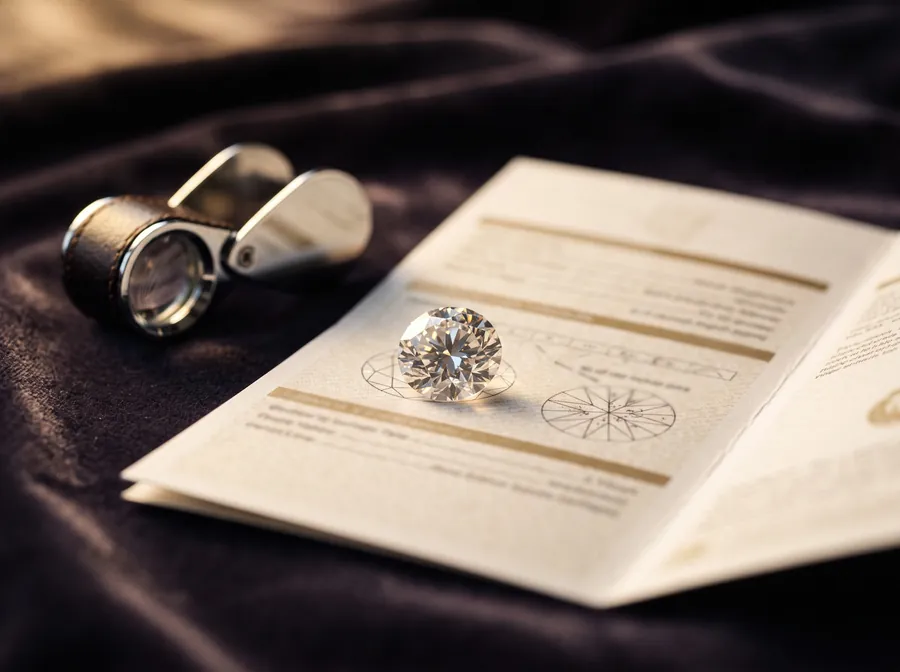
Rough and cabochon diamonds are the real novelty: both show a stone’s character instead of hiding it behind facets, which is why they need exceptionally clean rough. If one tempts you at a jeweler, ask for a laboratory report all the same; our guide to diamond certificates shows how to read it.